DENKMANN · STUDY
Denkmann strategy guide
Read the geometry, build a flexible opening, then calculate threats and earlier defenses. Finish with the positions where covering the last routes guarantees a draw. Use the interactive lessons to practice each idea on one shared cube.
Start with an opening ↓CHAPTER 1 · THE BOARD
Start with tic-tac-toe
It’s like tic-tac-toe: add one row and one column to make a 4 × 4 board, then play on all six faces of a cube.

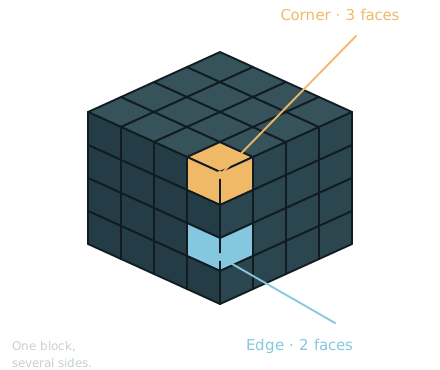
Take turns choosing an empty block. A middle block counts on one face, an edge on two, and a corner on three. One move claims the whole block, so you see your color on every face it belongs to.
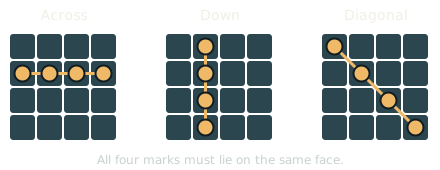
Get four of your color in a straight line on any one face to win: across, down, or diagonally. Lines through the inside of the cube don’t count.
Try a row ↗ Try a column ↗ Try a diagonal ↗
Build from there
Now look for lines you can build on more than one face, and learn the labels so you can follow a game.
One block, several faces
The example above shows why a corner, an edge and a face center contribute to different numbers of faces.
Read the label before reading the view
The number chooses a position viewed from above; A–D chooses its floor, top to bottom. Rotation changes the picture, never the label.
Coordinate map and floor labels
Try it: find 1A, then imagine the same block on Back and Left. Those are three views of one move, not three different marks.
CHAPTER 2 · OPENINGS, MOVE BY MOVE
Opening plans and defensive replies
The first block is an anchor, not an attack. Add a second mark that supports a useful route, then ask what remains after Blue interrupts it. Explore each plan and its defensive replies on the interactive cube.
Try the plan, then compare the interruption. Open a lesson to see the position, play the moves and compare defensive replies. These are model structures and verified tactical continuations, not a proven optimal opening repertoire.
The lesson positions use Denkmann’s board and legal histories. The teaching approach follows plans, annotated moves and defensive alternatives. It does not import chess’s center rules or Renju’s forbidden moves.
Sources for this style of opening lesson
Herman Grooten’s Understanding Before Moving 3, publisher sample ↗ uses highlighted targets and annotated model games to explain plans. The Renju International Federation’s visual rules tutorial ↗ presents line-game tactics with position diagrams; its opening tutorial ↗ also separates color assignment from ordinary play. Those are teaching references; Denkmann’s geometry and rules remain its own.
CHAPTER 3 · FORCING PLAY
Forcing combinations
A single threat demands one block. The combination comes from the next route that block leaves open. In the interactive lessons, follow the highlighted line, predict the reply, then find the surviving anchors.
Calculation exercise: stop one turn before the fork. Name both completion squares and check that the defender cannot win immediately. Two threatened lines ending at the same square are only one threat.
CHAPTER 4 · PREVENTIVE DEFENSE
Preventive defense
Trace an opponent’s next threat backward. Can you occupy its junction or close one required route now? A quiet preventive move can remove a chain before compulsory blocks leave you no choice.
Compare the timing: first watch the attack succeed. Then return one defender turn earlier and try the interruption. Stopping that sequence does not prove the whole position is drawn.
CHAPTER 5 · DRAWING DEFENSE
Drawing strategies
A route containing both colors never reopens. When your own open routes reach zero, stop building attacks and cover the opponent’s remaining possibilities.
- Low-density routes: close one each turn before the attacker can fill four.
- A shared square: one block can close several remaining routes at once.
- A pairing: answer either member with its partner, preventing ownership of the entire pair.
These are position-specific certificates. If both colors have no open route, the draw is mathematical even with empty blocks remaining.
CHAPTER 6 · OPENING RULES
Opening rules and balance
In Classic, you keep your assigned color. In Balanced opening, the proposer places Yellow, Blue, Yellow before the other participant chooses a color or extends the offer. A one-sided offer can be taken by the opponent.
After an extension of Blue, Yellow, the original proposer chooses. Blue moves next once colors are assigned. This adapts the RIF Swap2 opening procedure ↗; the cube’s winning lines stay the same.
Fairness and drawing are different. An opening can produce many draws while still favoring one participant in decisive games. Color choice changes the setup incentives; it does not guarantee equality.
CHAPTER 7 · YOUR REPERTOIRE
Analyzing your own games
Review three positions: the setup, the first compulsory reply and the final fork. The useful lesson is usually the move that connected them, not the last missed block.
- Save a plan with its routes and intended junction, not just its move order.
- Record the defensive interruption that makes you change plans.
- Return to your loss’s last voluntary turn and test an alternative against every forcing reply.
Practice: choose one of your games, stop before the first forced block and write down a preventive move. Check the other faces before accepting it as an improvement.
Further reading and practice resources
Board coordinates
Use the cube demonstration to find one label on every face that shares it. Separate a block’s location from the face you are viewing.
Explore the coordinate labels ↗Tactical exercises
Scan for your win, their win and distinct fork targets. Use the trainer to make predictions before revealing the reply.
Open the trainer ↗The worked forcing sequence
Step through the worked line. At each Blue turn, name the completion square that makes the block necessary.
Follow the cube demonstration ↗Opening plans, move by move
Follow a corner, edge or face-interior plan. Compare the defender’s interruption before repeating the sequence in your own game.
Explore the annotated openings ↗Beck: Tic-Tac-Toe Theory
Start with Section 5 and Theorem 5.1, printed page 74, for hypergraph games and strategy stealing.
Read József Beck’s book ↗Cambridge University Press · 2008 · PDFKrivelevich: Positional Games
A survey for the wider framework. See Theorem 4.2 for the Maker–Breaker potential criterion discussed above.
Read Michael Krivelevich’s survey ↗Author-hosted survey · PDFChessable: opening theory for beginners
Matthew Astle’s article explains the distinction between opening principles and prepared lines, and recommends understanding moves through game analysis. It is a useful model for studying; its chess-specific opening rules are not Denkmann rules.
Read the requested Chessable article ↗Matthew Astle · 9 June 2022REFERENCE APPENDIX
Evidence, formal theory and further analysis
The chapters teach playable ideas. Open the references below for exact records, mathematical arguments or implementation methods.
Opening comparisons and recorded reply maps
A recorded result is one continuation. Use the map to inspect an alternative defense, not to assume every later reply loses.
What the comparison tells us
The remaining theoretical question
Classic’s unresolved question is whether Yellow can force a win from the empty board or whether Blue can force a draw. Swap2 adds an opening-selection question: can a participant construct a position that remains favorable regardless of which color is selected? Neither the recorded tournaments nor the strategy-stealing argument resolve this. Balanced opening is an experimental way to change the incentive for the setup, not a claim that every offered position is equal.
Positional-game mathematics and primary references
The positional-game model
The cube can be described without its 3D drawing: take the 56 blocks as a set of vertices, and represent each of the 48 winning lines as a four-element set. Such a family of sets is a hypergraph. Both players try to claim every vertex of one winning set before the other does. This makes untimed Denkmann a finite strong positional game.
The model preserves shared blocks automatically. A corner is a single vertex belonging to several winning sets; it is not copied for each face. It also provides a precise distinction between a result in one recorded game, a forced win from a particular position, and a strategy that succeeds against every legal reply.
Strategy stealing and the first player
Beck’s Theorem 5.1, on printed page 74, states that the first player can force at least a draw in any finite strong positional game. Denkmann satisfies its assumptions when played without a clock. The reason an extra friendly mark can help the argument is that it cannot spoil the player’s winning set: claiming blocks has no adverse side effect such as making one’s own completed line illegal.
The theorem does not give a move to play. It excludes a forced second-player win under perfect play, while leaving open whether the first player can force a win or only a draw. A Blue victory in a tournament is compatible with it, because a bounded-search Yellow policy may make a mistake. Clock losses add another condition and fall outside this untimed result. József Beck, Combinatorial Games: Tic-Tac-Toe Theory, Theorem 5.1 ↗
Drawn positions and drawing strategies
A position is a proven draw if every winning line already contains both colors. Neither player can remove the opponent’s mark, so no later move can reopen a line. Our archive includes a validated 49-move example with this property, leaving seven unclaimed blocks.
See the 49-move draw on the cube ↗
This establishes that drawn positions exist. A drawing strategy is a stronger claim: it must explain how to reach a draw despite every possible opposing choice. Finding one drawn game does not establish that Blue can force a draw from the start.
Limits of a fixed pairing strategy
A possible defensive construction is to partition blocks into disjoint pairs, with at least one entire pair inside every winning line. Whenever the attacker takes one member of a pair, the defender takes its partner. If the construction covers every line, the attacker cannot own a complete line.
It cannot cover this board. Any pair of distinct blocks belongs to at most one of the 48 winning lines, as checked against the engine’s line list. The 56 blocks permit at most 28 disjoint pairs, so at most 28 lines could be covered that way. Ruling out this fixed construction does not rule out a position-dependent drawing strategy.
Explore shared lines and pairs ↗
Potential functions and their limits
A potential function attaches a numerical weight to each still-open winning set. The weight can increase as fewer unclaimed vertices remain, making it useful for measuring threats. In a Maker–Breaker game, only Maker seeks to complete a set; Breaker seeks to prevent all completions. This differs from Denkmann, where both players can win by completing a line.
See an open line gain weight ↗
The Erdős–Selfridge sufficient criterion for a Breaker win is Σ 2−|L| < ½. For the initial Denkmann line list, the sum is 48 × 2−4 = 3, so the criterion gives no conclusion. Failing a sufficient condition is not proof that the opposite result holds, and a result for Maker–Breaker still requires care before application to a strong game. Michael Krivelevich, Positional Games, Theorem 4.2 ↗
Earlier six-face forcing-line reference
Four compulsory blocks, then a fork
From the six-block setup, Yellow changes routes while reusing surviving marks. The final 3D threatens two different blocks: 3A and 2D. A block at either target leaves the other open.
The teacher shows the complete position on the cube, highlights the threatened routes and follows both colors through the forced replies. This proves the continuation from that setup, not a winning opening against every earlier defense.
Follow the forcing line on the cube ↗AI search, tournament methods and complete archives
This section explains the tools used to generate recorded positions. The strategic chapters above concern the game itself. A search algorithm’s preferences are evidence about that policy, not additional rules of Denkmann.
Search depth and unexamined replies
The Advanced AI combines a numerical open-line evaluation with tactical search. Iterative-deepening negamax examines legal alternatives at increasing depths. Alpha–beta pruning avoids branches that cannot change the current decision, and a transposition table reuses results for positions reached by different move orders. Forced-block extensions follow compulsory replies beyond the ordinary depth limit.
The evaluation uses weights for one-, two- and three-mark routes, but it does not prove that the preferred move wins. On budget expiry, the AI keeps its last completed search depth. A quiet combination beyond that depth may remain unseen. Equal-budget comparisons help measure the tested policies; solving a position requires enough analysis to account for every relevant reply.
Earlier style experiment · 1,989 games at 10,000 nodes
An opening result depends on the first move, the reply and the strength of both players. The experiment below compares Advanced search against Advanced search, with equal budgets and three evaluation preferences. It asks which openings and responses these policies handle well; it does not establish an optimal move from every position.
The full experiment contains 1,989 games: nine ordered style pairings × 56 starting blocks gives 504 games with an AI-chosen reply, and nine pairings × three representative openings × 55 replies gives 1,485 games with both opening moves imposed. The block-type table uses only the 56 Balanced-against-Balanced games from the first batch, so its totals describe that subset rather than the whole tournament.
Evaluation preferences and style matchups
All three styles use the same tactical checks. Balanced uses the standard open-line evaluation. Pressure values two-mark routes more highly, while Builder places more value on the first mark of a route. These are controlled differences in preference, not different rules or guaranteed descriptions of every move.
First moves and defensive replies
The first batch fixes only Yellow’s opening block and allows the AI to choose Blue’s reply. The second fixes both opening blocks and tests all legal replies to one representative of each block type. Keep those questions separate: a reply chosen by one policy is not the same as an exhaustive comparison of possible replies.
Recorded games and tactical patterns
Use the games to examine the transition from a quiet setup to compulsory defense. The important point for analysis is often the last turn on which the defender could still choose a preventive move, before the later sequence of forced blocks. Test a proposed alternative instead of assuming that the final missed block caused the loss.
Method, budgets and reproducibility
The Advanced-only experiment has 1,989 games across nine ordered style pairs. One batch imposes only the first move, cycling through all 56 surface blocks, and lets the AI choose the reply: 504 games. The other imposes a canonical first move from each of the three block types and all 55 legal replies: 1,485 games. These are two different experiments, not one opening win rate.
Balanced, Pressure and Builder share tactical rules and search. Their one-, two- and three-mark evaluation weights are respectively 3/30/250, 2/48/250 and 6/22/250. Every style uses the same 10,000-node, eight-ply ordinary depth limit and ten-second emergency deadline, with forced-reply extensions. Style labels describe evaluation preferences; they do not guarantee a particular playing behavior.
Every move is validated by the production engine. Games stop on a win or a proven dead draw. Comparing styles fairly means exchanging their seats on the same setup. Symmetries, deterministic tie-breaking and related setups make the samples correlated. Budget-limited self-play cannot prove a winning opening or perfect defense.
Download summary JSON ↗ · Download game archive ↗ · Download scripts and full research package ↗
Skill check · Advanced vs. Classic
This comparison measures the benefit of stronger search against the original heuristic. It is separate from the equal-budget style experiment above.